

The Thinking Lawyer: Legal Design, AI and the Architecture of Legal Intelligence
Traditional legal thinking alone is no longer enough. That was the hypothesis we set out to test on 22 April at the 35th Legal Tech Glögit, hosted by Castrén & Snellman.
The session continued the core mission of the Legal Transformation Network: to build a shared language for digital transformation in the legal sector. This time, we approached that mission through the lens of thinking.
The topic of the evening was ambitious. We set out to explore what kinds of thinking remain distinctly human, what kinds of thinking AI can increasingly support, and how legal teams should understand the relationship between the two. In the AI era, legal value is no longer driven primarily by legal knowledge, but by how legal teams combine different modes of thinking with data, processes and AI.
Castrén & Snellman hosted the network event for the third time. The session also connected naturally with our earlier discussion on The Skills of Future Lawyers, as thinking ultimately forms the foundation of the future lawyer’s skill set.
The evening was workshop-based and experimental in nature. A warm thank you to all participants for engaging so openly with a complex and still emerging topic. Based on the feedback received, the session gave participants new insights.
As organisers and designers of the workshop, we were also left with a strong sense that the dialogue was well timed and helped create new thinking. With this article we want to continue that conversation, and to look at how thinking decides where legal value is created in the AI era.
1. Where legal value comes from
Our contribution to the discussion began with where does value come from in legal work?
To frame that question, we briefly revisited the intellectual capital perspective. It reminds us that legal value is not created by expertise in isolation. Instead, it emerges through the interaction of human, relational, and structural capital.
In other words, in the legal field, client value also depends on trust, relationships, shared practices, shared knowledge, information structures, and the context in which legal work takes place.
As IT systems, data and large language models increasingly change how legal work is done, we need to look at how legal value is created more holistically.
Human capital, the lawyer’s own expertise, remains critically important. At the same time, client value can no longer be understood only through the legal knowledge of the individual lawyer.
It should be looked at how legal expertise connects with relational and structural capital and how AI can support all these areas.
If the architecture of legal value creation is changing, then the architecture of legal thinking may need to change as well.
2. Revisiting Legal Tech House as a shared language
To ground the discussion, we also approached the theme through the Legal Tech House framework, which has become a common language in our network for understanding how legal teams create client value, particularly from a structural capital perspective.
The framework makes visible that AI transformation is not primarily about implementing new tools on organisational level.
At its core, it is about how culture, data management, work design and service design combine into organisational capabilities that ultimately generate both client and financial value. The framework maps how legal teams value creation is enabled.
However, one key dimension has been missing. The framework has focused more on systems and structures perhaps reflecting the Legal Tech origins of the network, while the human dimension has remained less explicit.
By bringing thinking into the framework, we aim to make this layer visible.
This is how the first version looks:
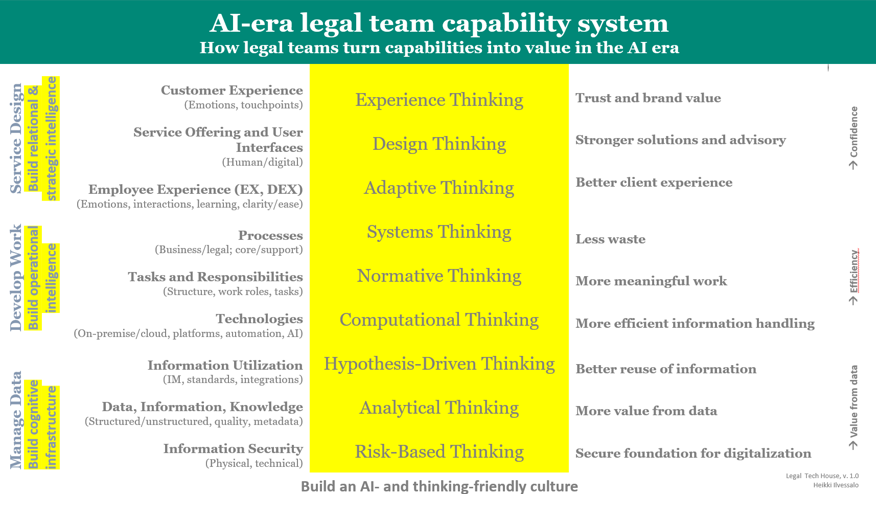
When legal teams are adapting to an AI-driven environment, we have to understand what kinds of thinking enable the core capabilities through which the whole team executes its unique strategy and creates extraordinary client experiences and value.
Thinking is the foundation of skills, capabilities, tasks and legal services. It is the cognitive layer that makes everything else possible.
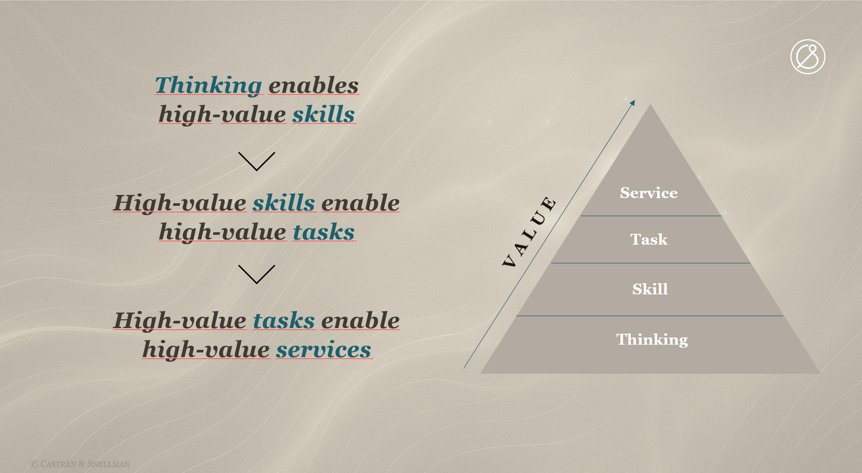
Seen this way, the conversation about AI becomes more human and about how client value is created.
3. From the individual lawyer to the legal team
One assumption behind the session was that the conversation should not be limited to an individual lawyer.
Traditionally, the professional identity of lawyers has been built around the individual expert. Lawyers have been seen as the bearers of knowledge, judgment, and responsibility like they’re the operating system of legal work itself.
Legal value creation needs to emerge from the interaction of people, information, technology, and organisational capabilities boosted by AI.
For that reason, the discussion was not framed solely around the question of what the future lawyer should think like. A more interesting question is what forms of thinking enable value creation in a legal team that integrates AI capabilities into their organisational design.
4. Human thinking vs. AI thinking?
This topic required unusually careful preparation, as there was no ready-made methodology for the discussion.
In addition to defining the broad scope of the topic in terms of the different dimensions of value creation, as described above, we selected the following themes of thinking as the basis for the dialogue.
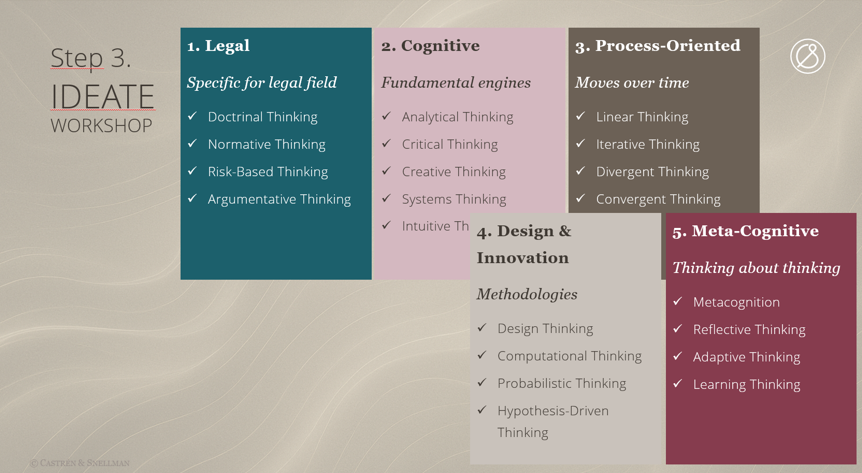
We asked participants which forms of thinking stay distinctly human in the AI era, and which play to the strengths of AI.
In the international discussion, a distinction between Judgement and Production types of legal work is becoming increasingly established. We chose to use this distinction as the framework for the workshop dialogues.
The aim was to make visible which forms of thinking are connected to the production of legal services and, on the other hand, to different forms of legal judgement.
Take an M&A transaction where AI can increasingly handle the review of documents, much of this due diligence process is production work. Drafting a first version of a share purchase agreement sits somewhere in the middle. The negotiation, where you weigh what matters to the client and decide how far to push, stays human.
The same holds across litigation and general advisory, with the balance slightly different in each. We don’t yet know the exact share of judgement and production in any given matter as that is part of what we are trying to understand. We believe breaking down a few familiar use cases this way starts to help build a shared language for understanding which forms of thinking and skills remain mostly human, and where AI may complement or take over parts of the work in which human resources and time is no longer the main source of value.
Our assumption was that work requiring legal judgement would remain more human-centred, while AI would increasingly take over thinking, skills and tasks related to the production of legal work.
4.1. Attendee reflection
The attendee reflections below show that the workshop made visible where the boundaries between human and AI capabilities may lie.
The value came from making thinking something that could be observed, questioned and explored together.
4.2. Attendee reflection — Lawyer and legal tech service provider
”To a point I most certainly agree with colleagues that doctrinal thinking might actually be better suited to AI than to humans. AI is already genuinely good at processing vast bodies of case law, identifying patterns, and applying established concepts. Better than a lazy lawyer, at least.
But, and this is a very big but, with flashing lights and exclamation marks kind of but, doctrinal thinking is not just pattern-matching. The deeper work involves normative judgment. So it’s not just describing doctrine, but asking whether it is coherent, fair, or justified. It requires constructing new legal concepts, carrying real accountability, and engaging in constant dialogue with society. Law does not develop in a vacuum. That part demands a human.”
Henna Tolvanen, read more
4.3. Attendee reflection — Student
“I was the chair for the metacognitive thinking session, and as the chair I noticed that it was quite a difficult topic for everyone and that it awakened various opinions and ways of thinking. I could clearly see the difference between an analytical thinker and a creative thinker like me. My task as the chair was quite difficult, in the sense that I had to gather all the thoughts from the groups and try to summarise it for everyone in the end without preparation. But it was a fun challenge and being surrounded by interesting people was a blast.”
Ida Ilvessalo
4.4. Attendee reflection — Legal tech service provider
“What I kept coming back to from that session was how much it challenged my own view of thinking. We tend to treat thinking as something internal and linear. You analyse, conclude, move on. But the discussion kept circling around a different idea. Thinking as something you can externalise, test, reshape and even share, especially when AI becomes part of the process.”
Karolina Silingiere, read more
5. What the workshop results seemed to show
The workshop results should be read as early signals rather than final conclusions.
Our 50 participants co-produced the results we had hoped for. The forms of thinking sorted into three groups.
More human-driven: Normative, reflective, intuitive, creative, divergent, design and convergent thinking.
In the middle, where AI may support, challenge or strengthen human thinking: Metacognitive, critical, argumentative, systems, learning, hypothesis-driven, iterative and risk-based thinking.
More AI-driven: Computational, probabilistic, analytical, doctrinal and linear thinking.

6. Why this matters in practice
If legal teams can identify which forms of thinking remain distinctly human, they can better protect and strengthen the capabilities that underpin the most valuable parts of legal work.
At the same time, identifying which forms of thinking are especially suited to AI support enables teams to redesign production work more intelligently. This does not mean that AI “owns” these forms of thinking, nor that humans cease to use them. Rather, it highlights areas where AI can increasingly deliver scale, speed and consistency in legal value creation.
By adopting a broader view of value creation, legal teams can begin asking better questions about how to remain relevant and trusted partners to their clients:
- What forms of thinking and skills should we deliberately strengthen across the team?
- Which parts of our work require human judgment, and which are repeatable and better suited to AI?
- How should we balance judgment-driven work with production work?
Legal expertise remains foundational. However, value is increasingly created through a legal team’s ability to reuse institutional knowledge, operate effectively within structured processes, interact with AI in a context-aware way, and apply human judgment where it matters most.
7. What next?
The next step is to keep testing these ideas in practice. A workshop was ran at FUTURELAW 2026 in Tallinn on 14 May, and the conversation continues at Legal Tech Talk in London on 15 June at the Legal Design Summit’s side event. The theme there picks up where this leaves off: what if thinking is no longer something you do alone, and what kind of thinker do you want to become?
This session was meant to open the discussion. We hope it offered new perspectives, and a practical way to rethink how legal value is created in the AI era.
