

When AI Takes the Production Work, What’s Left Is How You Think
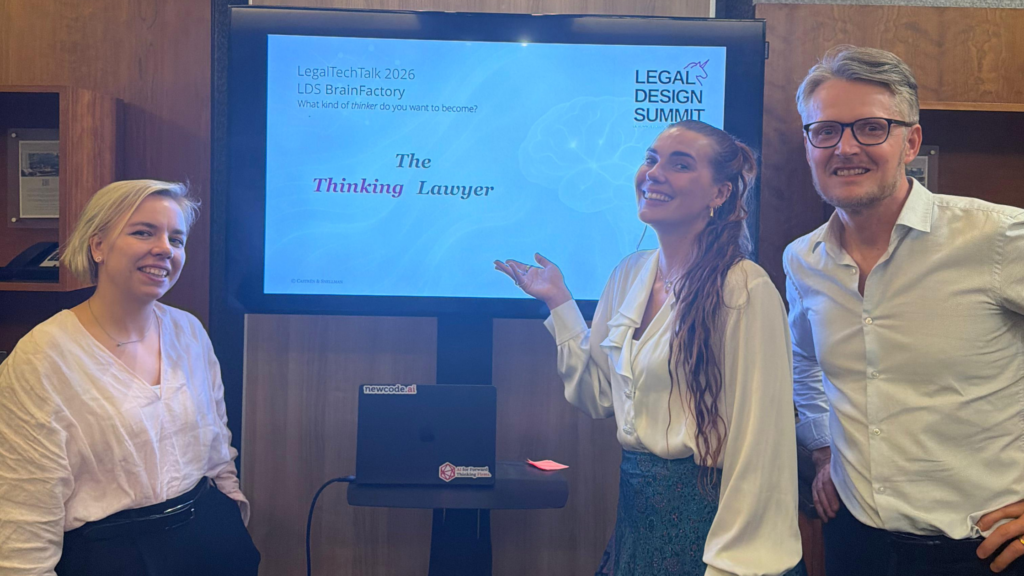
Which parts of a lawyer’s work are judgement, and which could AI take on? In June, we took the Thinking Lawyer BrainFactory to London and asked a room of senior professionals to answer that.
We ran the third iteration of the Thinking Lawyer BrainFactory as a side event at LegalTechTalk, hosted by the Legal Design Summit in collaboration with Newcode.ai. The room was full of senior professionals from across the legal field and around the world.
The workshop is a living experiment. We started in Helsinki in April at the 35th Legal Transformation Network event (aka Legal Tech Glögit), continued at FUTURELAW in Tallinn in May, and each time the concept develops a little further.
This time the work was more concrete than in earlier sessions as the participants took part in a mini design sprint on the art of thinking.
In London, we set three goals for the session:
- To create awareness of the different thinking modes and asking which ones you do and don’t use
- To activate the different thinking modes in your brain and put them to use.
- To experiment with the different kinds of thinking, and to explore where agentic AI might play a part in that.
Why we keep running this
The hypothesis behind the whole series is that traditional legal thinking, on its own is no longer enough in the AI era. For a long time, lawyers have drawn on a fairly narrow set of thinking habits. The work has been largely linear and top-down where you analyse, you conclude and then you deliver.
Now with AI, large parts of legal work can be automated which enables lawyers to work faster but the adoption curve is slow because a mindset shift is needed, and a mindset shift is deeper and more personal than installing a new tool. The reason why we are experimenting with this topic is to encourage other legal professionals to slow down and look at what has to be recalibrated at the level of thinking before the change can happen.
In a previous workshop, participants placed each thinking mode on a scale from human-driven to AI-driven, and we then treated the human-driven work as judgement work and the AI-driven work as production work. It is the opinion of fifty people, and it evolves as we keep testing it.
Thinking as the Foundation
Where does value in legal work come from? We believe that thinking sits underneath everything else. Thinking enables skills, skills enable the work, the work enables the services a team chooses to provide, and the services create the value. It is a deliberate simplification, but it puts thinking where we believe it belongs, as the foundation.
The conversation about AI therefore becomes more human and is focused more on how a team thinks, and how that thinking turns into client value.
The five categories of thinking
To make any of this usable, we needed a shared vocabulary. In all the workshops, we have grouped thinking into five categories. Note that this isn’t academic research, and we say so openly. It is a working map we have built and revised across the workshops, and we welcome people to challenge it.
The five categories are legal thinking, core cognitive modes, process-oriented thinking, design and innovation thinking, and meta-level thinking. Each one holds a set of more specific modes underneath it (read more about it in the previous blog).
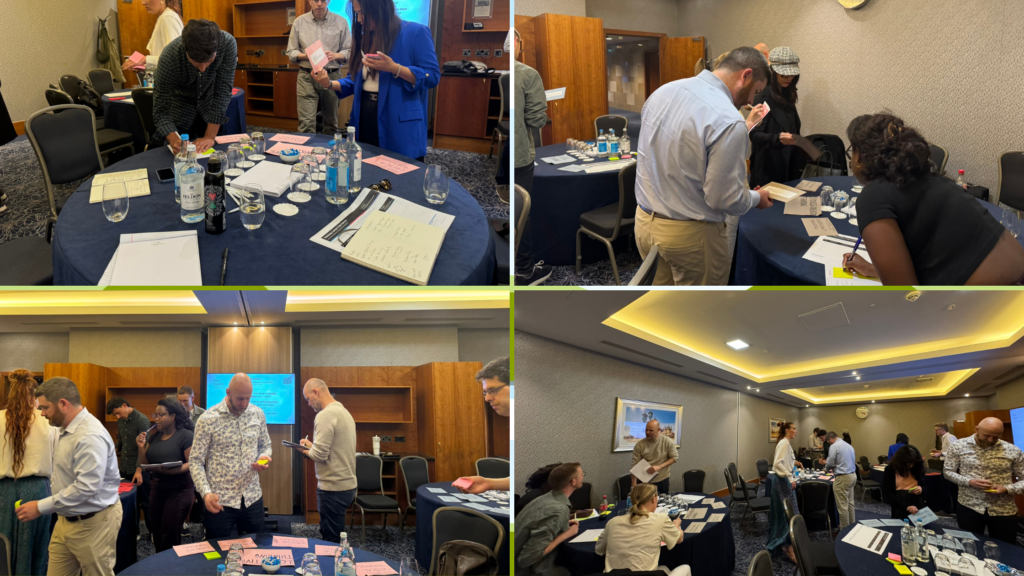
Before any group work, we laid the different types of thinking on cards across the tables, and asked everyone to walk the room and read them. We asked participants to reflect on:
- Which kinds of thinking are usually present in your work?
- Which have been missing lately?
- What kind of thinker do you want to become?
Starting with individual reflection encourages participants to think about how they currently work. Some participants expressed how they had no idea there were so many different types of thinking, others found they were applying all of the thinking at some point.
Meta-level thinking (thinking about thinking) came up as the category most easily overlooked. We’d also argue, it’s the one that grows in value as AI can handle more routine work. When the production work is increasingly handled for you, the thinking that’s left is the thinking about how you think.
Choose the thinking before the agent does
The key design decision was about who chooses the thinking. You could let the agent decide for itself which thinking modes to apply, and it will but we deliberately asked people to choose first.
Each table was given a Thinking Lawyer Case which was a realistic scenario that you can expect in a law firm and in-house, and they were asked to break the case down into phases. There were five groups in the room, and they rotated between the tables so that everyone worked through several different cases.
One table looked at how a multinational company would roll out an AI-based employee monitoring system, another stress-tested an AI-generated legal strategy for an EU-US data transfer that looked convincing but might hide flaws or missing nuance. Others looked at redesigning a due diligence process with AI to improve quality and reliability, designing a new AI-enabled service to help clients manage EU AI Act compliance, and improving a legal team’s overall AI adoption where use was inconsistent and practices were not shared.
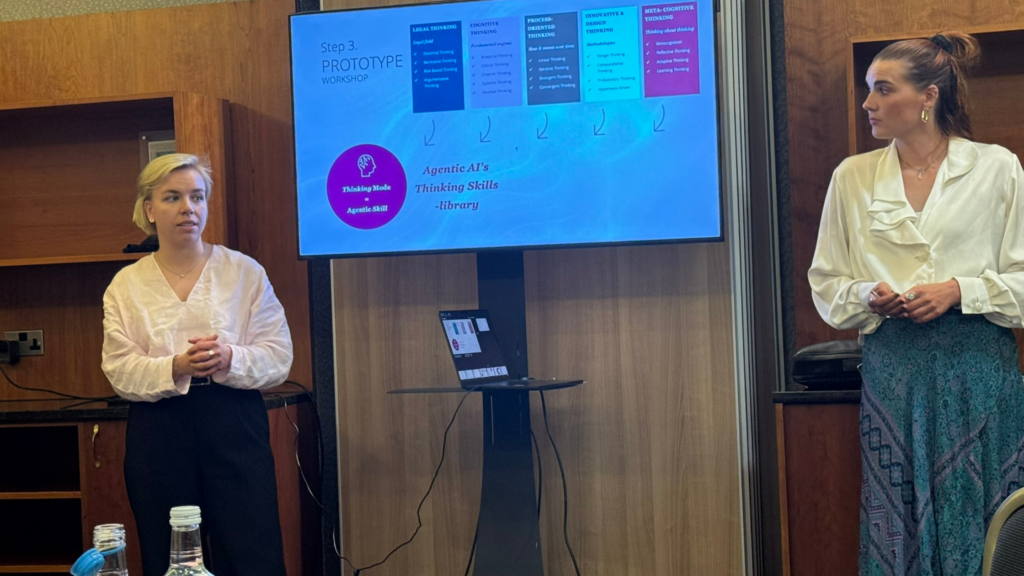
The aim was to make people more aware of the thinking modes so they can direct the AI agent. At each table, one person stayed as the Chair to gain an overview of the case and reflected back the findings of each phase to each new group.
The session’s starting hypothesis was AI as a second brain, an extension of our own thinking rather than a tool sitting outside it. If AI is a second brain, it can take more than one role. The AI agent could take one of two roles:
As an AI coach, it works on judgement not doing the thinking for you, but expanding it, helping you move between thinking modes and apply them yourself.
As an AI-Lawyer, it supports production work. It leverages the same library of thinking modes to carry out a task and save you time.
One role is meant to develop the person and the other is meant to free the person up. Both are useful, but they are not the same thing, and a firm that only ever uses the second is getting speed without getting better.
Where the judgement sits
This is harder than it sounds, and that is the useful part. The moment you force the distinction onto real work, the questions get sharper. Where exactly does the judgement sit? Which steps could a model handle, and which only look automatable until you examine them closely?
That difficulty is also why AI adoption in law firms is slow. A firm can buy the tools long before it can answer which parts of its own work should change. You can’t decide what AI should take on until you have looked closely at the work and seen, step by step, where the judgement sits and where it doesn’t.
We don’t yet know the exact share of judgement and production in any given matter. Working out that share is part of what we are trying to do but breaking a few familiar cases down this way starts to build a shared language for where human thinking stays central, and where AI can take on parts of the work in which time and effort are no longer the real source of value.
From the room
The most interesting answers came out of the discussions inside each group. The group was mixed, with legal ops people working on AI transformation inside firms, knowledge management lawyers, practising lawyers, academics, legal service providers and legal engineers.
“I chaired the table working on AI adoption, where a legal team’s use of AI was inconsistent and good practice wasn’t being shared. What stood out was hearing each group work through the phases, and that no phase ever resolved to a single mode of thinking. People reached for several at once and each phase required both judgement and production work. There was no one or the other. It was also eye-opening to learn about the different modes of thinking.”
Alison Yuen, Legal Content Specialist.
“I was thinking more in the role of running a business and dealing with a team, so convergent thinking, creative thinking, and cognitive thinking are things that I think about right now, in terms of what is not present, the legal thinking and I don’t probably design and innovate in that way, I’m more thinking on the go rather than spending the time to actually set aside to design and, and think what I would like to see would be divergent thinking and also meta cognitive cognitive thinking. I also chaired one of the cases and it was interesting to see the different approaches from each group. Each group became more streamlined and quick to adapt as the phases progressed.”
Jeremy Small, CEO of Legal Recruitment and Legal Tech Consultancy
“Metacognition is the most powerful form of thinking, and as AI becomes more powerful, it is metacognition will remain one of the last strongholds of the human thought. Humans must avoid the temptation of cognitive surrender. Some studies that show the more you use AI, the greater propensity you have to surrender your cognition, and thus do not develop the advanced thinking necessary for high-level thought. When AI is used as a substitute for human judgment, it’s like going to the gym and bringing along the machine that lifts the weights for you. The weights move but it benefits you not at all. I think there’s significant threats to use AI to our own cognition that can erode our thinking. How we can regain our high-level cognition in the shadow of AI is something I’m interested in.”
Robert C. Bird, Professor of Business Law & Eversource Energy Chair in Business Ethics at the University of Connecticut School of Business
How this changes management, hiring and investment
Once you can see which thinking a piece of work needs, you can describe in concrete terms, the thinking your team already has and the thinking it is missing. That might change how you manage, hire, and how you buy. If you understand where in a process a certain kind of thinking is needed, you can say why a particular investment, whether a person or a tool, belongs exactly there.
To proceed at an organisational level, we should start building the dataset and the tools that make the share of judgement and production work visible, and therefore manageable.
How much of the change is about thinking at all, rather than the human and cultural side of how we work and who we are?
Designing an environment where thinking can thrive
Making thinking visible is only the first step. The interesting part begins when people try to move between different ways of thinking in practice.
What we noticed in the room was how much of this transformation happens in the interaction between people. When participants explained their reasoning, challenged each other’s assumptions and built on different perspectives, the value came not only from the final answer but from the thinking process itself.
This is something we need to pay attention to as AI becomes part of our work. If more of the production happens in the background, we need to become more intentional about the environments, cultures and moments that develop our judgement.
Because thinking is not only an individual skill. It is also something we practice together.
That might be one of the next questions for us to explore: how do we design organisations where both humans and AI continuously improve the quality of thinking?
This concept develops further every time we run it. Thank you to LegalTechTalk for the platform, and everyone who participated. The next iteration is already on our minds.
To stay up to date on what we’re learning, follow the Legal Design Summit, Ilves, and Newcode.ai on LinkedIn.
Heikki Ilvessalo, CEO at Ilves
Mia Ihamuotila, Legal Tech & Design Lawyer at Castrén & Snellman Attorneys Ltd
Malin Männikkö, Product Lead & PhD Candidate at Newcode.ai
